Idle disk cleanup
Turn unattached and stale storage into owner-assigned cleanup work with evidence, risk notes, and verification criteria.
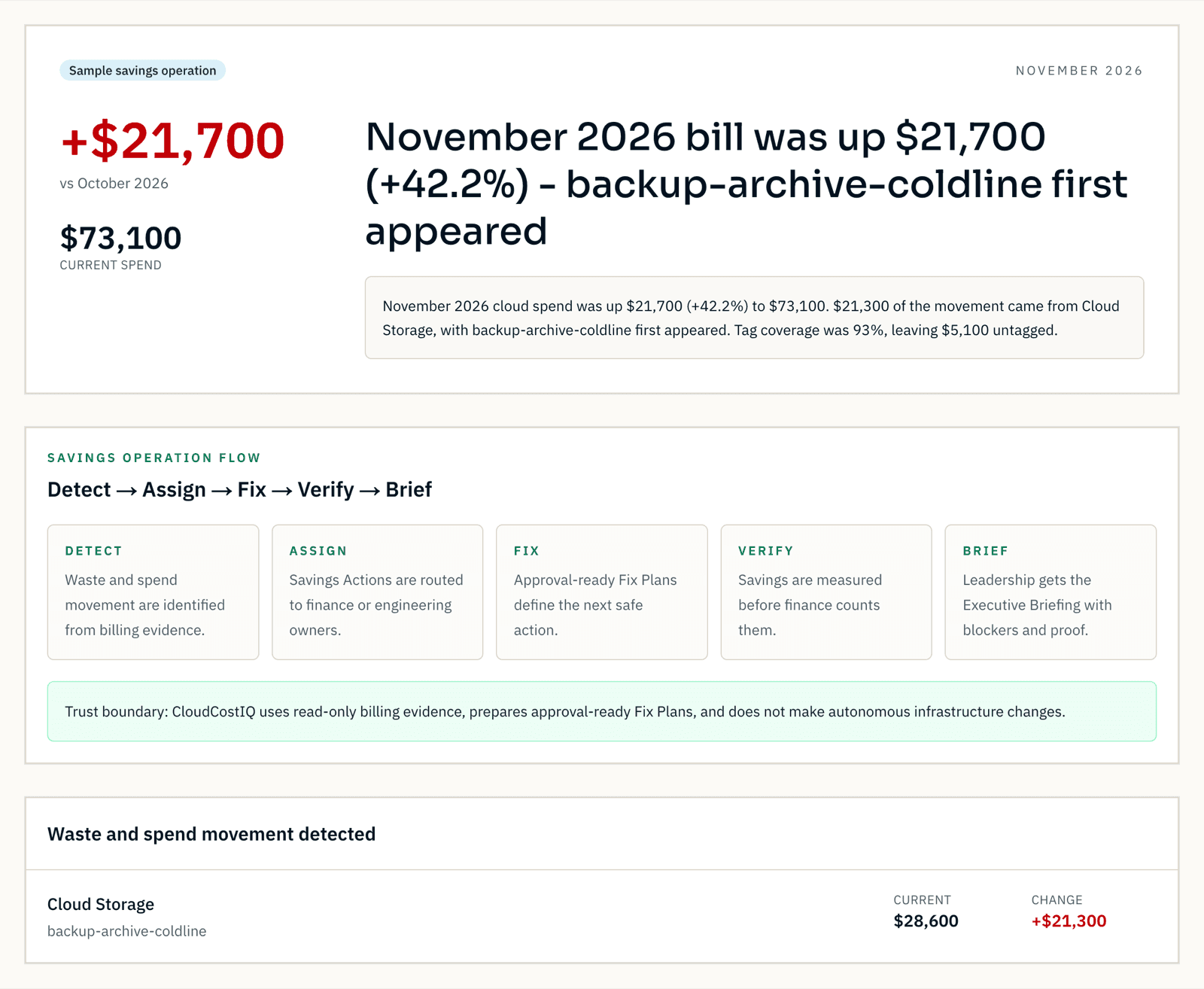
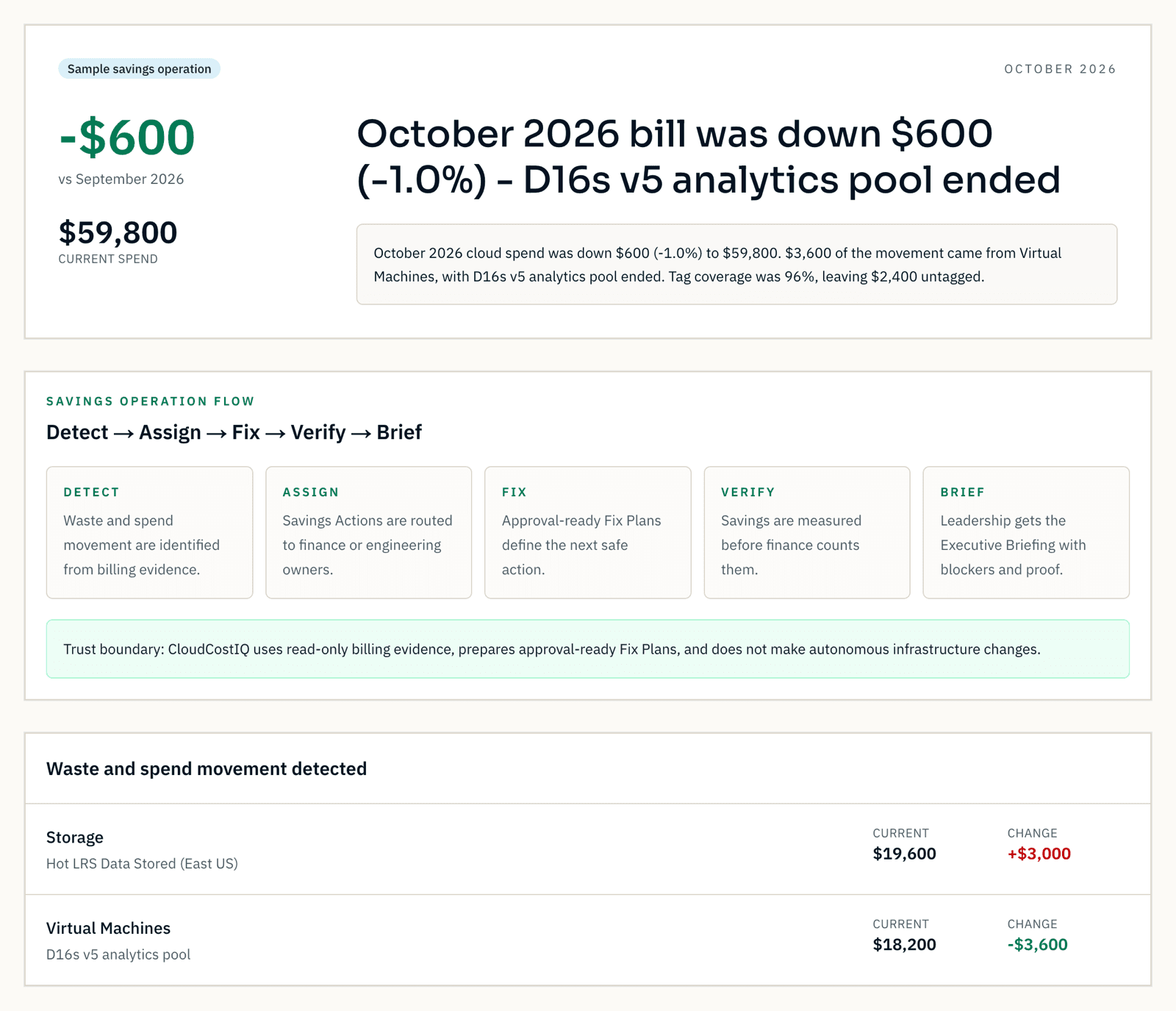
CloudCostIQ runs a 30-day savings pilot that finds waste, gets owners assigned, prepares approval-ready Fix Plans, follows up on blockers, verifies savings, and gives finance a proof packet.
Built for Series A-C SaaS teams spending $25k-$250k per month on cloud that need FinOps execution without a dedicated cloud finance team.
Launch wedge: non-prod scheduling, idle storage cleanup, tag policy work. Human approval required for infrastructure changes.
Idle storage, non-prod scheduling, and transfer growth are ready for owner review with evidence and approval-ready Fix Plans.
Transfer growth explains most of the variance. The highest-impact savings work is non-prod scheduling, unattached storage cleanup, and a commitment coverage review. Every Fix Plan waits for owner approval before implementation.
CloudCostIQ supports human-reviewed accountability workflows. It does not make autonomous production changes.
Every month has a moment where leadership asks what happened. CloudCostIQ makes that answer available before the review starts: what changed, why it moved, what to say, and who owns the next step.
Cloud spend increased $2,561 versus the prior completed period, with 72% of the movement tied to transfer volume and production compute.
At the current burn rate, budget risk appears before month-end unless the transfer spike is expected customer growth.
Engineering owns the transfer review; finance owns the forecast update; two Savings Actions are ready for verification.
It is a lack of shared language, decision rights, ownership, and proof. Telemetry can tell you what happened. Leadership needs to know what it means and who is accountable.
Cloud spend is now a business operating system. Most companies still explain it like an engineering log.
A board asks why AWS or Azure is up. The answer lives across billing exports, deploy notes, and three Slack threads.
Finance owns the forecast. Engineering owns the infrastructure. Nobody owns the explanation.
Savings programs look impressive until someone asks which savings actually appeared on the next bill.
Dashboards create more views of the problem. They rarely create a decision owner.
CloudCostIQ turns billing evidence into a shared operating record: the executive answer, the finance implication, the engineering follow-up, and the terminal outcome for every savings action.
The movement, the driver, the date, and the financial size.
The operational cause in language finance can forward.
Budget exposure, confidence, and whether the work belongs in the pilot.
Named engineering owner, finance approver, or explicit blocker.
Day 7, 14, 21, and 30 checkpoints with SLA-backed follow-up.
A proof packet separating verified savings from blocked or rejected work.
Cloud spend changes every week. CloudCostIQ turns that movement into a managed operating loop your team can approve without building a mature cloud finance function first.
CloudCostIQ starts with billing evidence, spend movement, and the highest-value waste signals.
Every Savings Action gets a named engineering or finance owner, due date, or explicit blocker.
CloudCostIQ prepares approval-ready Fix Plans with context, risk, next steps, and rollback notes.
Implemented work becomes verified, excluded, regressed, or blocked before finance counts it.
Leadership gets the savings closed, blocked, pending approval, and recommended next decision.
The pilot focuses on savings categories where the service can produce accountable work: impact, confidence, risk, owner, approval path, implementation evidence, and day-30 verification.
Turn unattached and stale storage into owner-assigned cleanup work with evidence, risk notes, and verification criteria.
Separate safe cleanup candidates from retention-sensitive snapshots so engineering can approve the right work quickly.
Prepare schedules for staging, QA, and development environments that can stop outside working hours after owner approval.
Package lifecycle changes with expected savings, rollback notes, excluded data classes, and measurement windows.
Expose ownerless spend and drive it to a named owner, an agreed policy change, or a blocker in the proof packet.
Route RI, Savings Plan, and committed-use decisions through finance approval rather than automatic purchase advice.
Most cloud tools stop at “you could save this.” CloudCostIQ follows the money through ownership, implementation, verification, finance review, and a terminal state for every action.
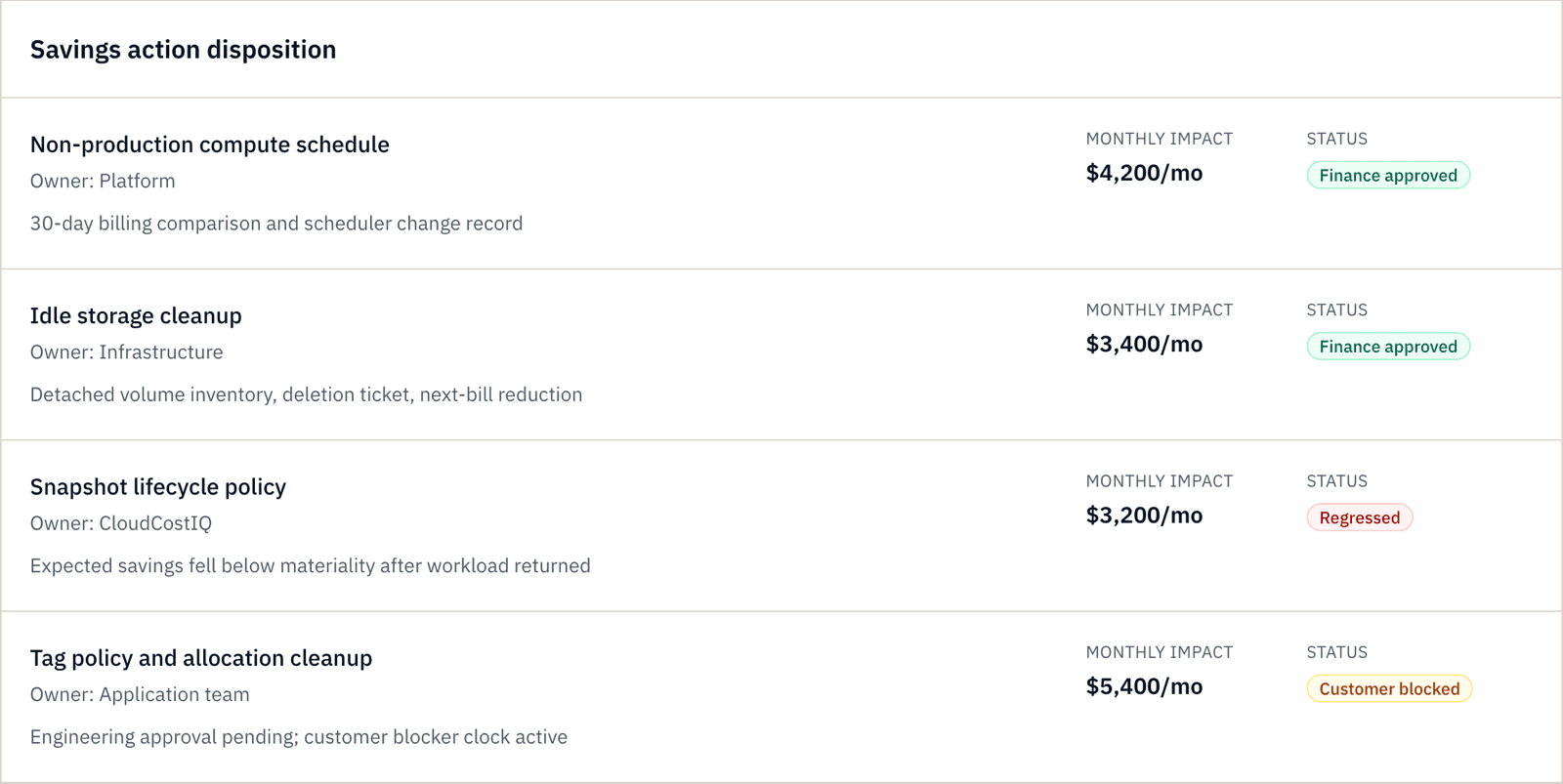
Savings Proof is the difference between a savings claim and a financial outcome. Leadership can see what was verified, rejected, regressed, expired, customer-blocked, or still open.
You provide billing exports, invoices, or read-only cloud cost connections. CloudCostIQ scopes the first three savings categories.
We translate spend movement, budget risk, and owner-ready savings into a weekly operating review.
We assign owners, chase blockers, prepare Fix Plans, capture implementation evidence, and verify realized savings.
CloudCostIQ moves teams from “we might save money here” to a managed queue of actions with owners, blockers, evidence, and a finance-ready verification path.
CloudCostIQ prepares the owner-ready Fix Plan, approval path, expected savings, due date, and verification window for staging, QA, and development waste.
CloudCostIQ attaches resource evidence, risk notes, rollback guidance, and the financial implication before engineering removes anything.
CloudCostIQ routes reserved capacity decisions through finance approval instead of treating purchase suggestions as automatic changes.
Budget confidence improves when teams can see which services moved, what changed operationally, and which optimization work can reduce the run rate.
At current burn, spend crosses the approved monthly budget before month-end.
Forecast increased because compute and data transfer are running above trailing baseline.
Classify variance as expected growth, planned work, budget risk, or monitoring only.
CloudCostIQ uses AI to explain spend movement and prepare evidence-backed work packets, but deterministic calculations, evidence, and human approval stay authoritative. Engineers get context without autonomous changes.
Review security postureDollar figures, percentages, forecasts, and savings measurements come from structured calculations before any narrative is written.
Savings Actions link back to billing evidence, confidence, risk, implementation guidance, and verification method engineers can inspect.
Uploads, reports, findings, actions, and audit records are scoped to the organization at the database layer.
CloudCostIQ can prepare implementation plans and PR evidence, but it does not make autonomous cloud infrastructure changes.
CloudCostIQ does not need broad production control on day one. It earns trust by owning narrow savings work to terminal states, then expands into operator coverage and outcome pricing where evidence, owners, approvals, and margin support it.
CloudCostIQ is priced around completed operating work: owner follow-up, approval-ready Fix Plans, customer blocker escalation, verified savings, and outcome billing for qualified accounts. The launch motion is a fixed-fee pilot with day-30 acceptance criteria.
CloudCostIQ runs a 30-day pilot across three low-risk savings categories and exits with assigned work, blockers, and finance-ready proof.
CloudCostIQ owns the savings queue between meetings and produces the deliverables needed to close approved savings work.
For accounts where evidence, owners, approvals, permissions, and gross margin support CloudCostIQ taking outcome exposure.
Managed accounts get explicit service ownership. The pilot is not complete until every savings item is assigned, blocked, verification-ready, verified, rejected, regressed, or expired.
This is the launchable 9/10 wedge: narrow scope, named buyers, explicit proof, and a binary day-30 decision instead of another dashboard subscription.
Inspect the evidence system behind the managed pilot.
Give finance and engineering the workflow used by the operator.
Standardize savings evidence, approvals, and proof across teams.
For companies that want CloudCostIQ accountable for a managed savings program across finance, platform, and leadership.
Platform access exists so buyers can inspect evidence, assignments, approvals, and proof. The business model is the managed savings operation: a base operating fee plus verified-savings upside for qualified accounts, so CloudCostIQ earns more when real cloud savings are proven. Savings operations commonly convert thousands per month into owner-ready or verified Savings Actions depending on environment size and tagging quality.
Outcome contracts are qualified before the first paid review. CloudCostIQ checks spend, evidence coverage, owner paths, approval speed, permission readiness, addressable waste, and operator margin before offering verified-savings pricing.
The output is a launch decision: 30-day pilot, operator coverage, verified-savings contract, platform-only inspection, or no-fit.
Start with three low-risk savings categories, named owners, blocker follow-up, approval-ready Fix Plans, and a day-30 finance proof packet.